Those few seconds of silence are more normal than you think.
"If both companies made you an offer, how would you decide?"
Most people have an answer somewhere in their head. Then they sit down across the table and it vanishes. Then the panic sets in — three seconds of silence surely reads as having no opinion — so they start talking, and the more they talk, the less order there is.
The question isn't hard. What's hard is that you haven't had time to take it apart.
First, make the question clearer
Psychology has a term for this: cognitive load — the mental resources it takes to process information. Attention and short-term memory are finite. In an interview you are simultaneously parsing the question, composing an answer, and reading the interviewer's face. Three things at once; the buffer empties.
Freezing doesn't prove incompetence. But the reverse is also true: not every blank can be blamed on nerves. Some questions genuinely expose a gap in knowledge or experience, and those two cases should be handled differently.
The steadier move is to buy yourself a few seconds: "Let me think about this along a few lines."
One sentence. It gives you room to organise, and it sets an expectation that there is a structure coming.
If the question is long, play it back in your own words:
Are you more interested in how I judge opportunities, or in what I'd actually do with two concrete offers?
That isn't politeness. The same wording can hide very different things being tested. If they want decision criteria, explain your criteria. If they want career planning, explain why those criteria serve your long-term goals.
But clarify in moderation. Keep asking when the question is already clear and it starts to look like avoidance.
Work out which kind of question you're stuck on
A question you can't answer is not one kind of question. There are at least three, and they call for different handling.
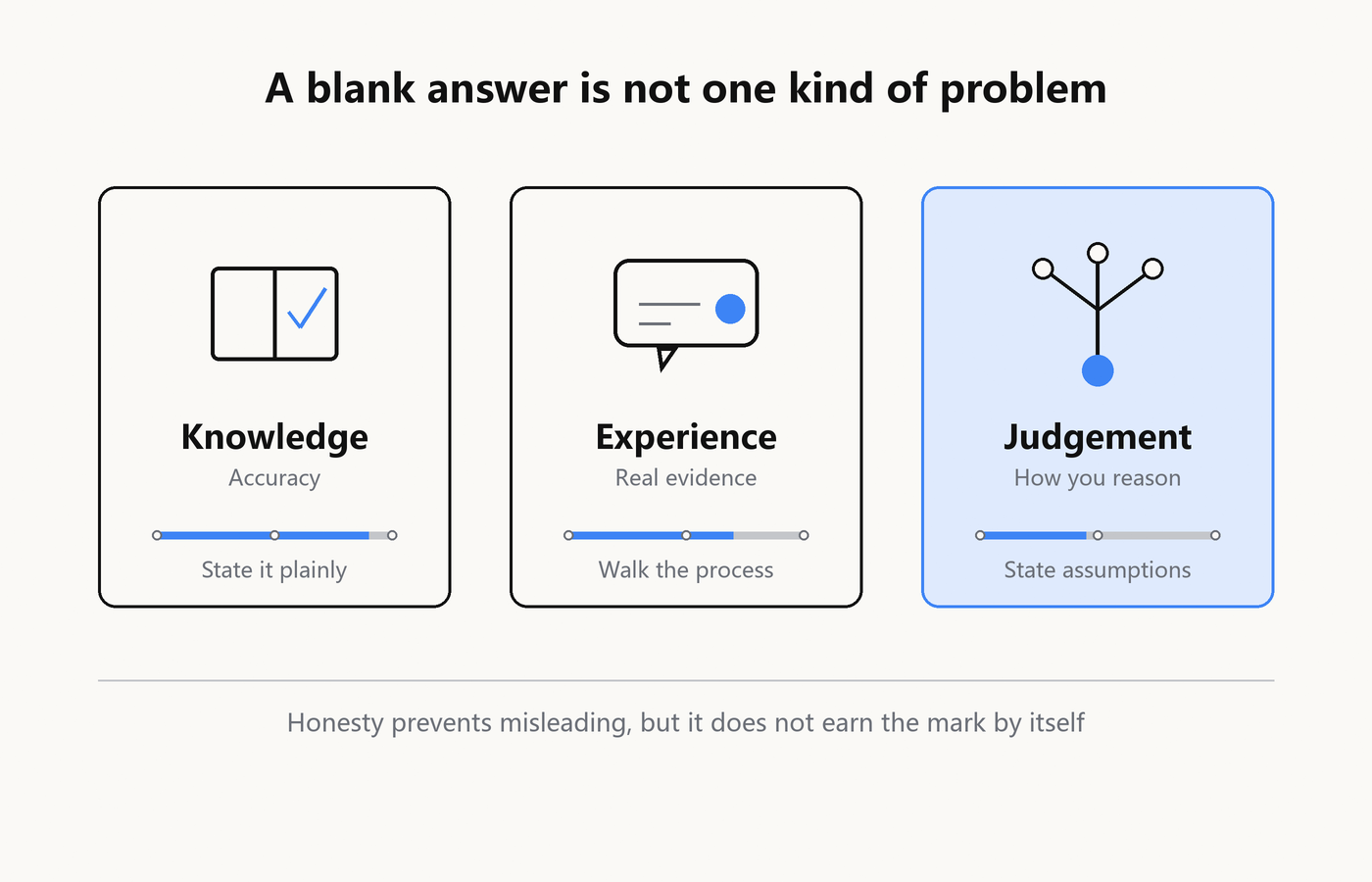
Knowledge questions. Accuracy matters more than fluency. Say the parts you're sure of. Where your recall is shaky, say it needs checking — far safer than improvising from impression. For a technology you've never touched, don't pretend otherwise: "I haven't worked with that directly, but I understand the class of problem it solves" is a legitimate answer. If you don't even know the principle, admit it and say where you'd go to learn.
But note: a learning plan is not experience. If the role requires independent command of a core skill, they are entitled to read that as a mismatch. Honesty prevents misleading; it does not guarantee a high score.
Experience questions. These want real behavioural evidence. With no exact match, find a case with similar responsibility, difficulty, or approach — then describe the situation, what you did, and how it turned out. That is more reliable than a polished borrowed story.
Open judgement questions. Here they want to see how you frame the problem and whether you can reason sensibly on incomplete information. State your necessary assumptions first, then walk through your thinking.
One concept is useful for calibrating yourself: confidence calibration — whether your stated certainty matches your actual accuracy. In interview language:
- Established facts: state plainly
- Inference from limited information: "I'd lean towards…" or "under these conditions I'd prioritise…"
- Genuinely unknown: acknowledge it needs verification
That lets the interviewer separate what you know from what you judge from what remains open. Don't be falsely modest when you're sure, and don't perform certainty when you have no basis for it.
Comparing two offers: put five dimensions on one line
Back to the original question.
There's no universal answer — it depends on the person and the career stage. But you can build a consistent basis for comparison.
Visual design has a principle called alignment: arrange elements along a shared reference line and the relationships between them become legible. Present two sets of information in the same structure and the differences surface on their own.
Job offers work the same way. Argue that company A pays more while comparing it against company B's atmosphere, and you are comparing two different things — the conclusion is meaningless.
Scope of work, pay structure, management style, growth opportunity, cost of living. Five dimensions is enough.
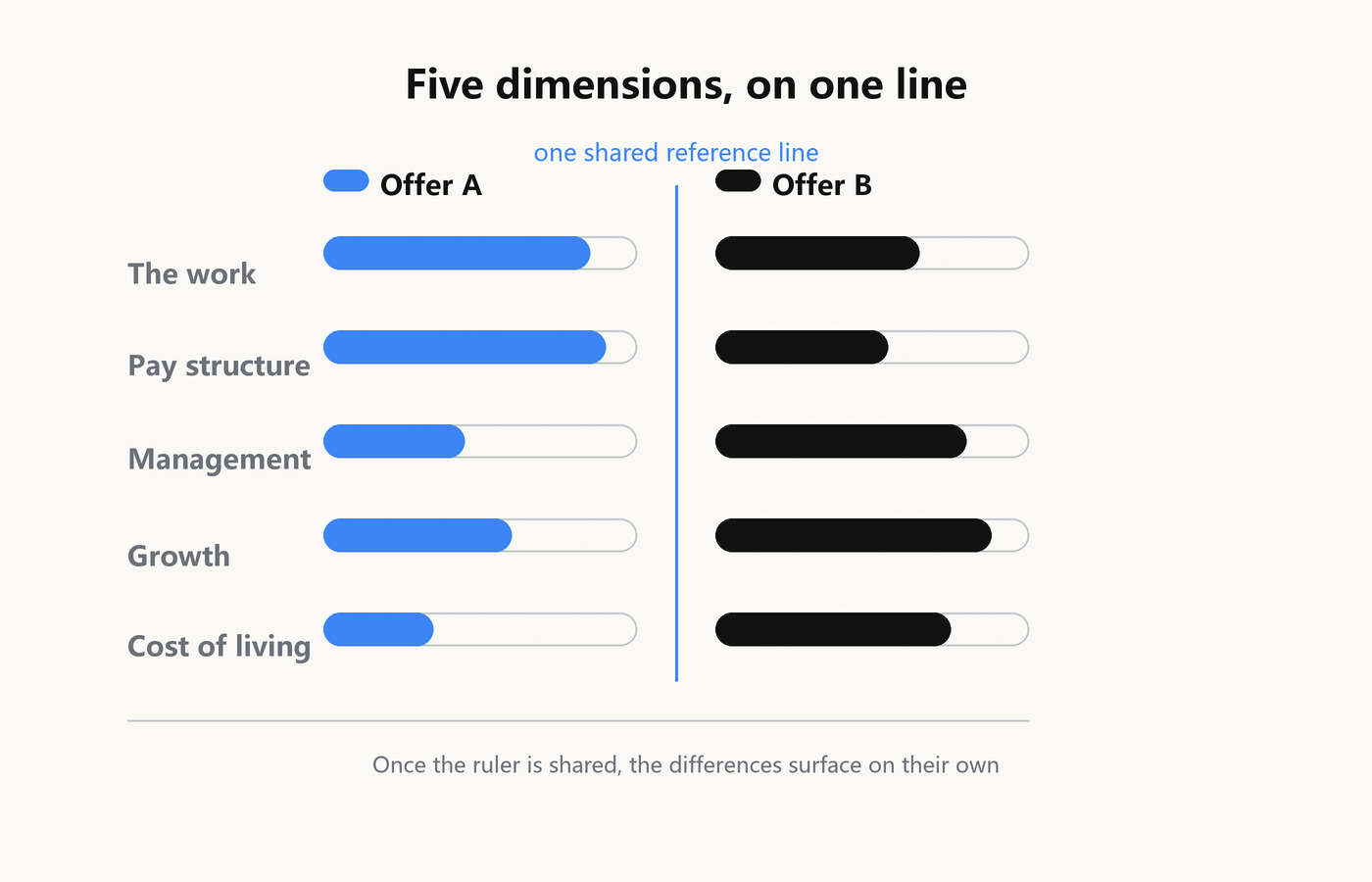
Scope of work decides where your hours actually go. The same job title can mean very different things: two "project manager" roles, one weighted to execution, the other to coordinating resources and owning delivery end to end. Don't read the title, read the daily tasks, the boundaries of responsibility, and the actual goals. If the work drifts away from your interests and abilities for long enough, no salary will keep you engaged.
Pay structure needs unpacking. Base salary, performance bonus, benefits, equity — each carries different conditions and different risk of not materialising. Some packages look large because a big share is variable; if it depends on team performance or company results, it isn't stable income. Compare by separating what you can count on from what has conditions attached.
Management style shapes the daily experience. Some managers set clear goals and step back; others favour process checks and frequent reporting. Neither is inherently better, but fit varies by person and by task. If you need room for independent judgement, watch how the team assigns work and how disagreements get settled.
Growth opportunity is about what you'll accumulate. "Lots of room to grow" doesn't mean everyone gets an equal share. The information that's actually worth something: will you touch complex projects, will you get expert feedback, are promotion criteria clear? Unclear criteria make the growth story unverifiable.
Cost of living is not a footnote. The same salary in cities with different costs leaves very different amounts in your account. Rent, transport, daily expenses — and commuting time, because those two hours a day are also a cost.
Put those five together and you have a reasonably complete picture.
But they don't have to carry equal weight. Decision research has a technique called multi-criteria decision analysis: compare options across several criteria, then weight by how much each criterion matters to you. It explains precisely why the same pair of offers produces different conclusions for different people. Early in a career, scope and growth may lead. Carrying a mortgage, stable income and cost of living may come first. Wanting to balance work and family over the long run, management style and time demands become decisive.
The same person will reorder them at different stages.
One more thing: some conditions are floors and can't be offset by other advantages. A job can pay very well and still not be worth taking if the sustained intensity exceeds what you can absorb. So prioritise the dimensions — but don't force every difference into a single score.
You don't need to show the arithmetic in the room. If the interviewer understands which factors you weigh, why you rank them that way, and how you'd trade off under different conditions, you've given a persuasive answer.
When information is missing, say how you'd get it
Having a framework doesn't mean you can conclude on the spot. Much of what matters isn't available before you join.
The posting is clear enough, but it can't tell you how the team actually works day to day. The interviewer described the direction, but you still don't know the mechanism for developing people.
Missing information is itself a condition of the judgement — not noise you can pretend isn't there.
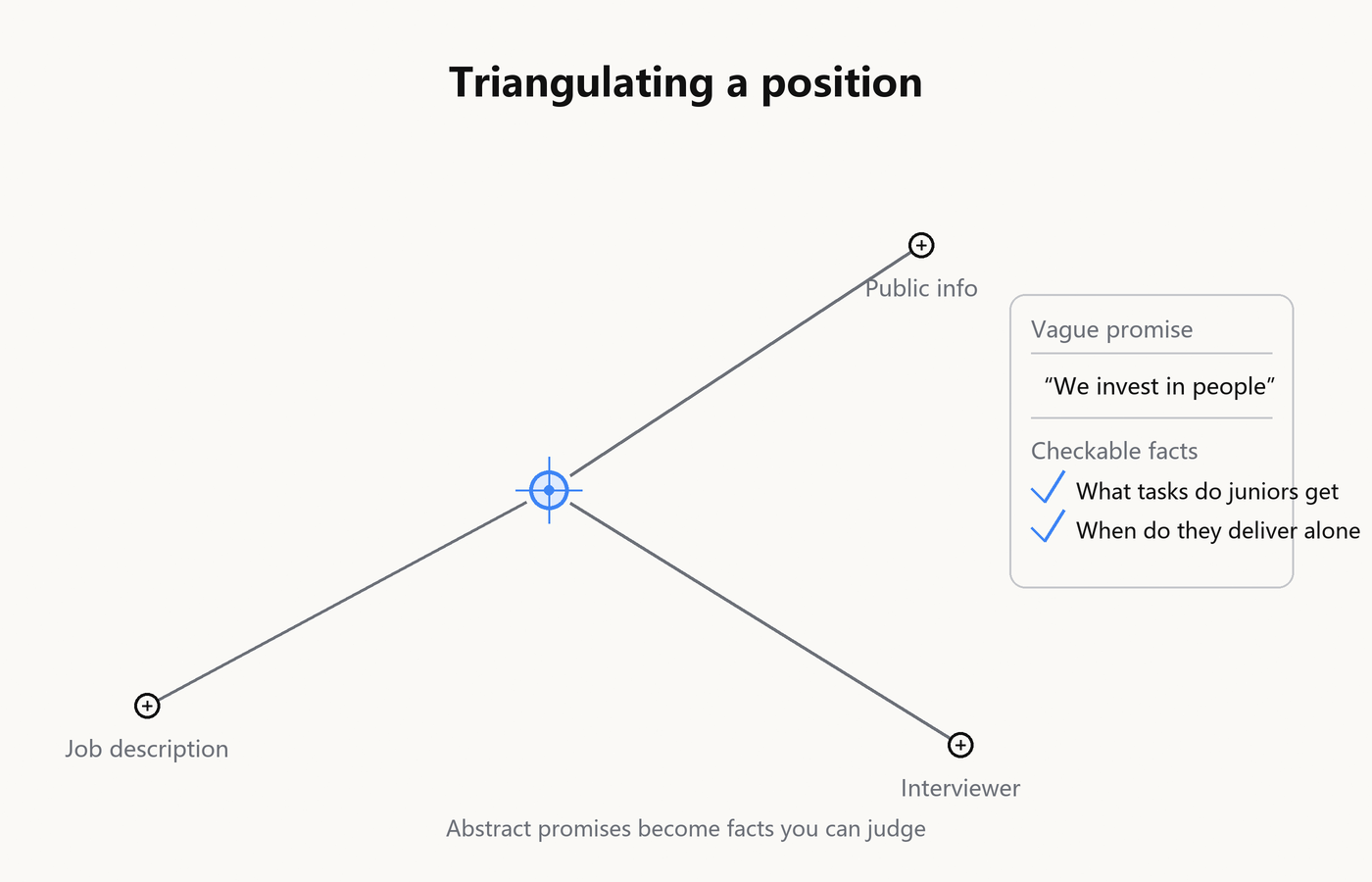
Navigation has a technique called cross-bearing positioning: take bearings on several known landmarks and let the lines intersect to fix your position. The lesson is that you shouldn't trust a single direction.
You can't get an exact intersection out of a job offer, but you can let sources check each other:
- Posting says "you'll own projects independently" → ask how far the decision authority actually reaches
- Company stresses "generous performance bonuses" → confirm the calculation, the conditions, and the timing
- Interviewer says "we invest heavily in juniors" → ask which tasks typically produce that growth
Abstract promises become checkable facts, one at a time.
If sources contradict each other, keep verifying. If key conditions stay unconfirmed, fold that uncertainty into the decision.
But more sources doesn't automatically mean a better conclusion. Several people may repeat the same recruitment script — it looks like corroboration while adding almost no independent evidence. So check where information comes from, and whether it actually describes this specific role.
Time matters too. Astronomy has light travel time: light takes time to reach you, so a distant object appears as it was in the past.
Job information carries the same lag. Employee reviews from several years ago may have value, but they may not describe today — the management team has changed, the business direction has shifted, the internal rules have moved. One team's past experience isn't the team you're joining. And a company's past growth doesn't by itself guarantee anyone's promotion.
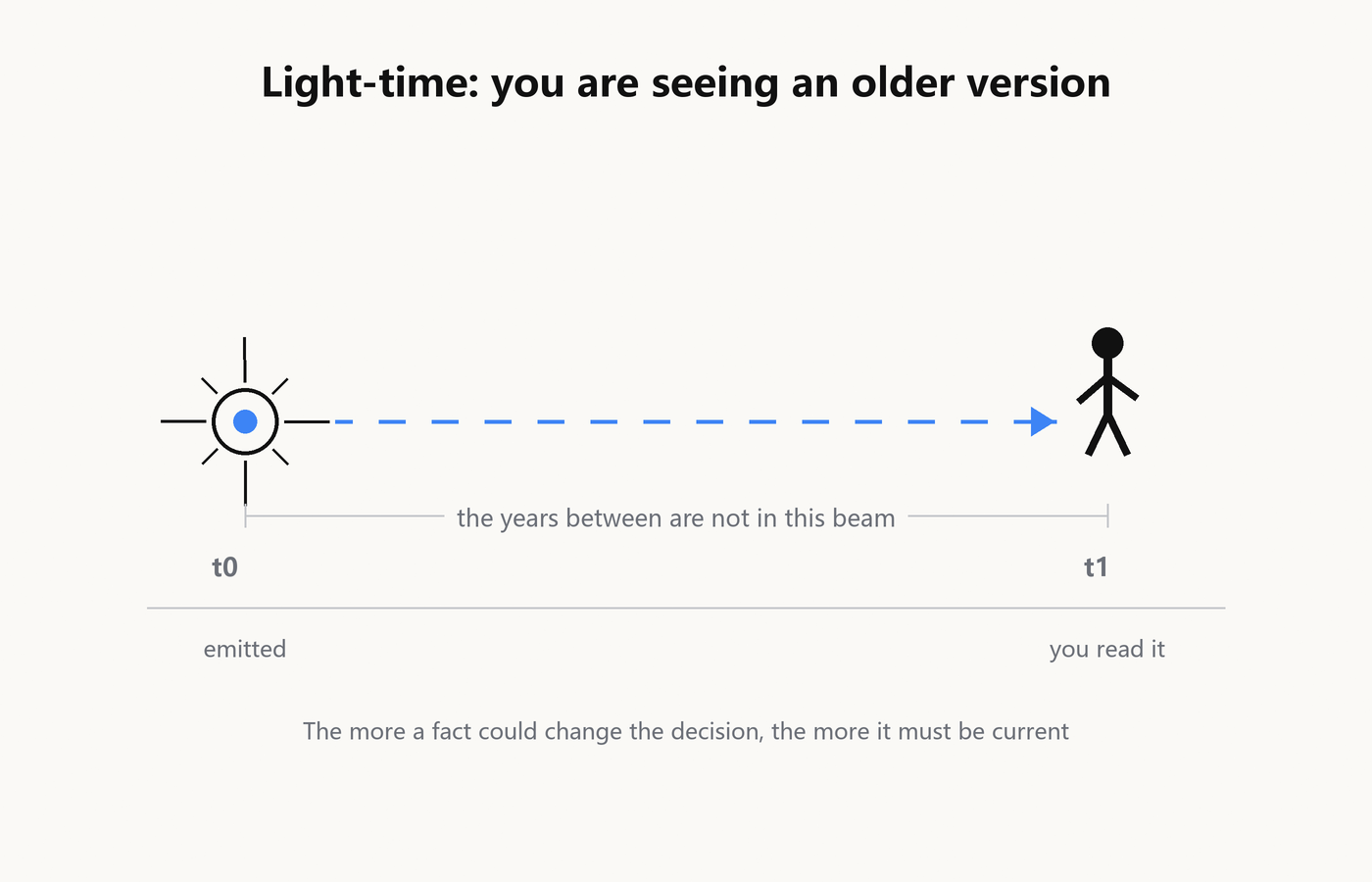
So: the more a piece of information could change your decision, the more it needs to be current, specific, and verifiable.
If you can't get an answer in the room, state your conditions plainly:
To make a final call between two offers, I'd still want to confirm the team's performance criteria and the actual responsibilities of the role.
That shows you know what would change your mind.
Don't ask endlessly to look thorough, though. Whether something is worth pursuing depends on whether it could change the conclusion — if no answer would alter your choice, don't spend the interview on it. In limited time, resolving the uncertainties that matter beats covering everything.
Let them hear your reasoning
Assembled into one answer, it sounds roughly like this:
If both offers fit my general direction, I'd compare them on scope of work, pay structure, management style, growth opportunity, and cost of living.
Scope determines whether I can stay engaged day to day; pay structure has to be read together with cost of living, because what I care about is the real return; management style shapes daily collaboration; growth opportunity determines what I accumulate over the next few years.
After that I'd weigh them against my current career stage to decide which conditions have to be met first. If important information is still unclear, I'd verify before deciding.
That answer doesn't rush to crown a winner, but the criteria, the order of judgement, and the basis for the decision are all visible. The interviewer can follow up.
For instance: "What if one pays more but offers less room to grow?"
You don't need a new framework. State your minimum income requirement and how much you currently weight growth. If stable pay covers your needs and the next few years are a formative period, growth leads. If you're carrying defined family expenses, payable compensation moves up.
Now your choice has reasons rather than a feeling.
But don't turn everything into an open discussion. If the question asks for a specific piece of knowledge, answer the knowledge. If it asks for an example, give a real one instead of staying in the framework. And where safety, compliance, or significant operational risk is involved, don't speculate about unfamiliar steps just to sound complete — clear logic helps you communicate, but it doesn't substitute for expertise.
Afterwards, use the blanks
The questions you couldn't answer make the best preparation list:
- Forget technical knowledge often → shore up the fundamentals and where they apply
- Can't find examples → catalogue the projects you've worked on and problems you've solved
- Know the material but ramble → practise identifying the question type, then landing two or three key judgements
- Afraid of saying the wrong thing → practise separating established facts, reasonable inference, and things needing verification
One unanswered question doesn't define anyone's ability. But how you handle an unanswered question does shape their read on how you work.
Because real work is full of questions with no standard answer, incomplete information, and demands beyond your experience. Noticing in time what you don't know is the first step in avoiding a bad call. Taking a complicated problem apart is how you find what to look at next. Adjusting your conclusion on new information shows your judgement isn't locked to a first impression.
So when you can't answer, you don't need to prove you know everything, and you don't need to give up on answering because you stalled. Work out whether the question wants knowledge, experience, or analysis — then decide whether to answer directly, add a case, or build a comparison.
Three things tell you whether you handled it well:
Whether what you know is accurate, whether the reasoning is clear, and whether the unknown part was handled honestly and concretely.
Adapted and reorganised from a long post by @yunbiyun.