On the evening of 15 October, Tesla livestreamed a second launch for the second-generation Roadster from SpaceX's McGregor test facility in Texas. The car first appeared in 2017, when delivery was promised for 2020. It has slipped ever since — close to nine years now.
What the demo actually showed
The car drives up a long curved ramp, upside down, launches off the lip, rotates back to upright in mid-air, and lands on four wheels. It then jumps over a row of Teslas, Semi truck included.
"Flying cars are real," Musk said on stage.
Physically, that isn't a lie — the car did leave the ground. But it is a long way from what "flying car" usually means, and the distance is easiest to see in how it works.
Where the "flight" comes from: one tank of compressed air

It uses cold-gas thrusters. The principle is close to a full balloon darting around when you let go of the neck: compressed air sits in a carbon-fibre pressure vessel and is released hard through nozzles, producing thrust. No fuel is burned and there is no flame.
Tesla says the thrusters put out four to five times the grip limit of the tyres, which is why it can launch far harder than wheels alone allow.
Staying stuck to the ramp while inverted is a separate system: fans pull air out from under the car, pressing it onto the surface. The two get conflated — the thrusters do the jumping, the fans do the sticking.
So the "flight" is a few seconds of jet-assisted hop. When the air runs out, it's over. That is a long way from a car that carries you somewhere through the air.
The demo car isn't the one you can order
Two details about the car in the video are worth separating out.
According to the tech outlet Glitchwire, the demo car swaps its rear seats for a pressure vessel holding 260 kg of compressed air, with ten nozzles around the body. The Information reported earlier that the thrust and noise are so extreme that the demo car is driven remotely.
Tesla has not confirmed any of this. But even setting those claims aside, "a car that can go on the road" and "a car that can somersault" are not the same car — which is exactly what the version split below makes plain.
Three versions, and only one can't go on the road
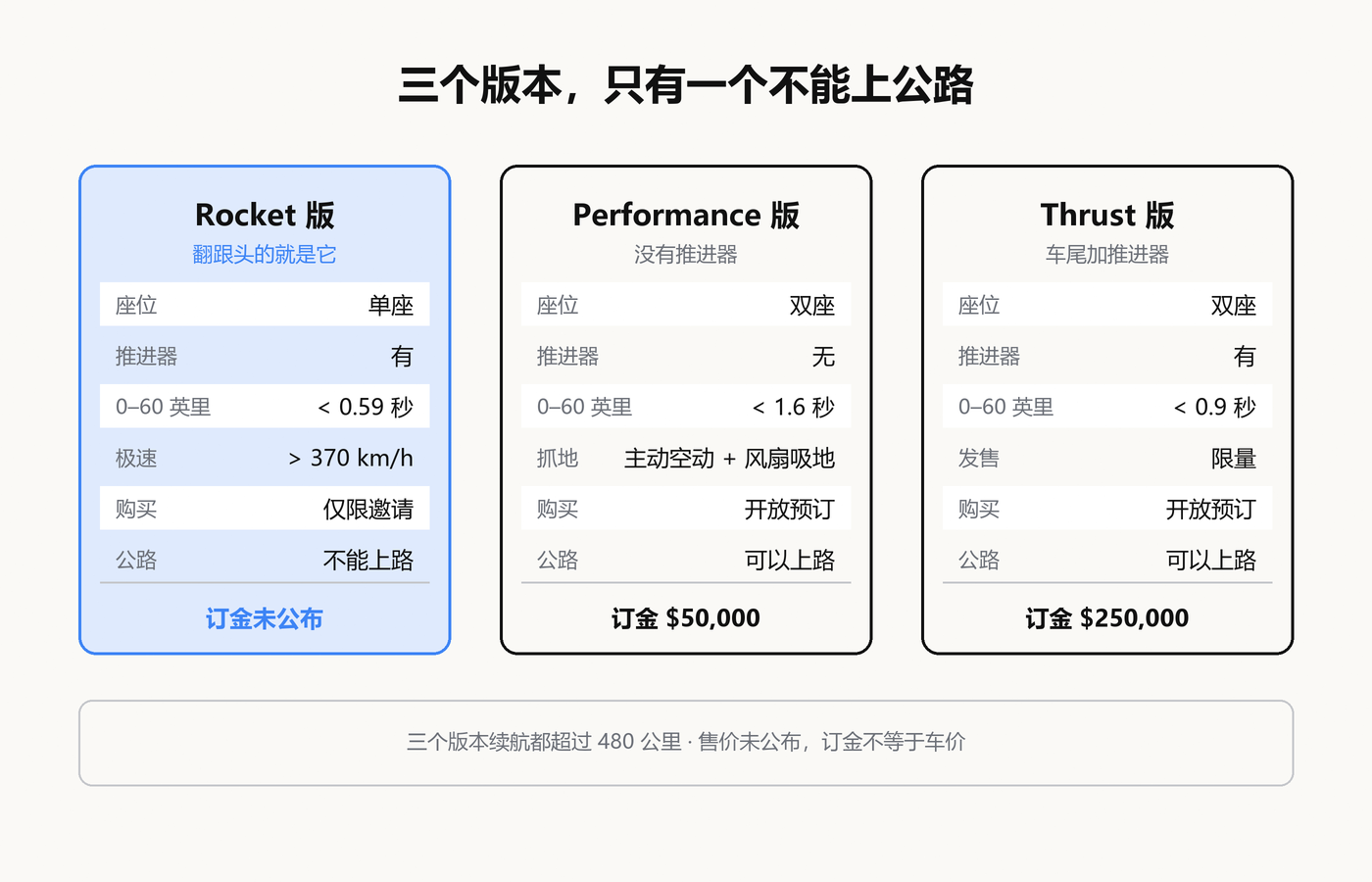
The Rocket version is the one that flips: single seat, invitation only, and not road legal. Zero to 60 mph in under 0.59 seconds, top speed above 370 km/h.
The two versions ordinary buyers can order are both two-seaters:
- Performance has no thrusters. It relies on active aerodynamics and downforce fans for grip, reaches 60 mph in under 1.6 seconds, and takes a $50,000 deposit.
- Thrust adds thrusters at the rear, reaches 60 mph in under 0.9 seconds, is a limited run, and takes a $250,000 deposit.
All three are quoted at over 480 km of range.
One detail on the Performance deposit is worth reading closely: the $50,000 comes in two payments — $5,000 first, which Tesla says is fully refundable, then $45,000 within ten days, or the order is cancelled. The design intent is to make holding a place in the queue cost something.
No price, and no delivery date either
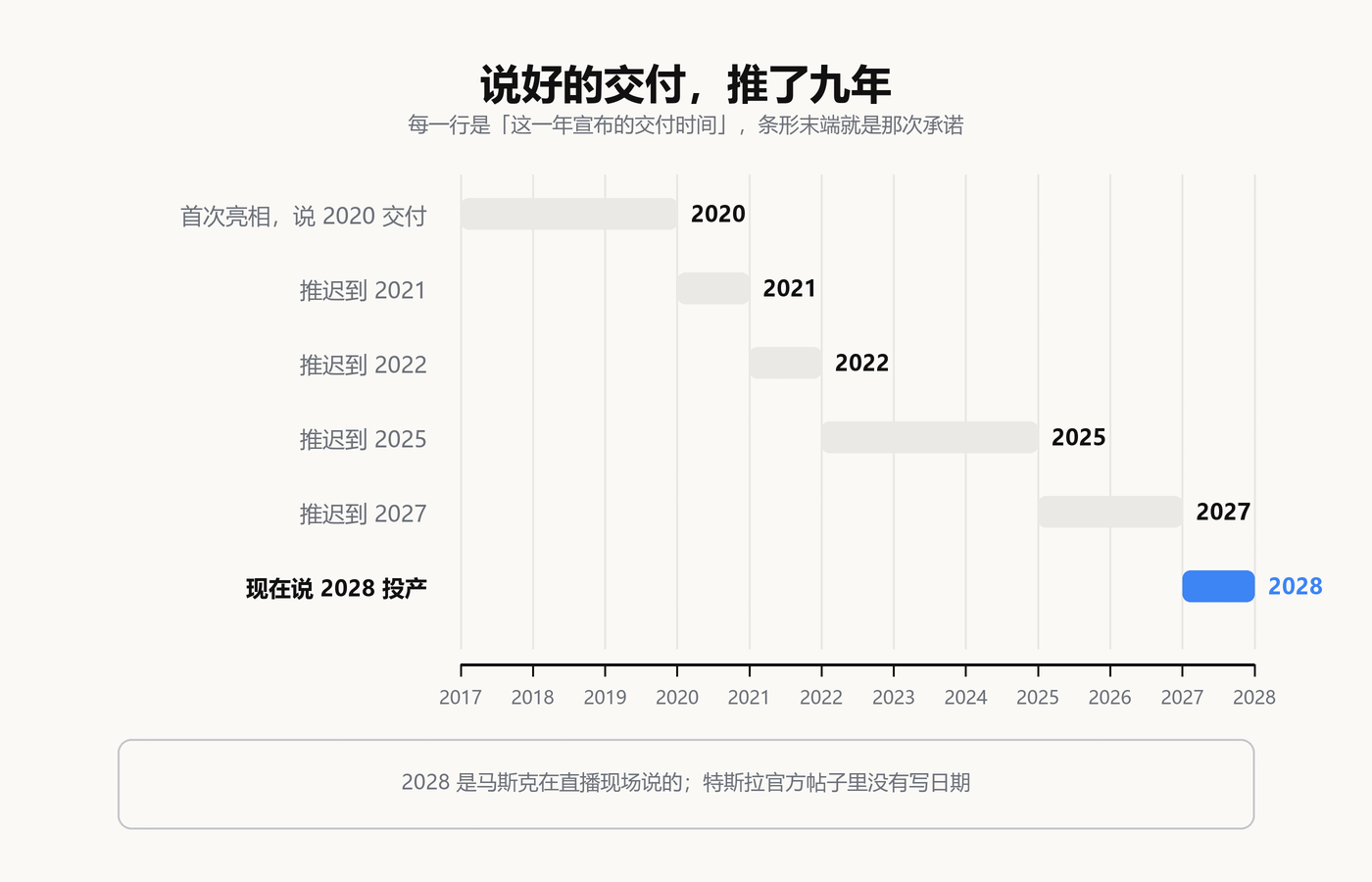
Tesla has not announced a price. A deposit is not a price — the 2017 figure was a $200,000 starting point, and nobody has said whether that still holds nine years on.
Production is 2028 according to Musk on stage. Tesla's own post does not carry a date. Meanwhile the car's delivery window has already moved from 2020 to 2021, 2022, 2025 and 2027.
One note on the framing
The most valuable thing about this demo is that it says plainly what the car can and cannot do: the Rocket version is labelled single-seat, invitation-only, not road legal. An engineering prototype that has no intention of going on the road is more honest than one that keeps the limits vague.
The framing is what deserves scrutiny. "Flying cars are real" is true in a physical sense, but it is very easy to hear as "Tesla has built a flying car." What actually happened is that a car hopped for a few seconds on a tank of air and then came down — no passengers in flight, and no meaningful endurance in the air.
Nine years have passed since that first reveal. Every step along the way has been "a bit longer," and this date is still a verbal one. If you want to know whether this car ships, there will be plenty more chances to check that sentence before 2028.